Choosing a first robot kit
Buy for the thing you want to learn, and for the way the kit can grow, not for the most dramatic photograph.
What a first kit is for
A first robot is a teacher. It should let you see a motor turn, a sensor report a number, and a piece of code change the motion. If a kit arrives as a sealed toy that you cannot open, program, or break and repair, it may be fun, but it will teach you less.
This is not a review of every kit on the market, and it is not a claim that we have built them all. It is a way to read a product page. The home page of this site already names one kit for a first robot, one for a first arm, and one for a more serious build, each with a reason and a catch, and with no affiliate link. Use those picks if they fit. Use the questions below if they do not.
Questions that matter more than the brochure
Can you program it with a language or a block environment you can actually learn from, and can you later reach the underlying code? A kit that starts with blocks and later lets you write real firmware is a better teacher than one that locks you in a closed app.
Can you see the motors and the sensors, and can you replace or add one? A closed shell looks tidy and makes the first hour easier. It also hides the parts you came to understand. Look for a frame you can get a screwdriver into.
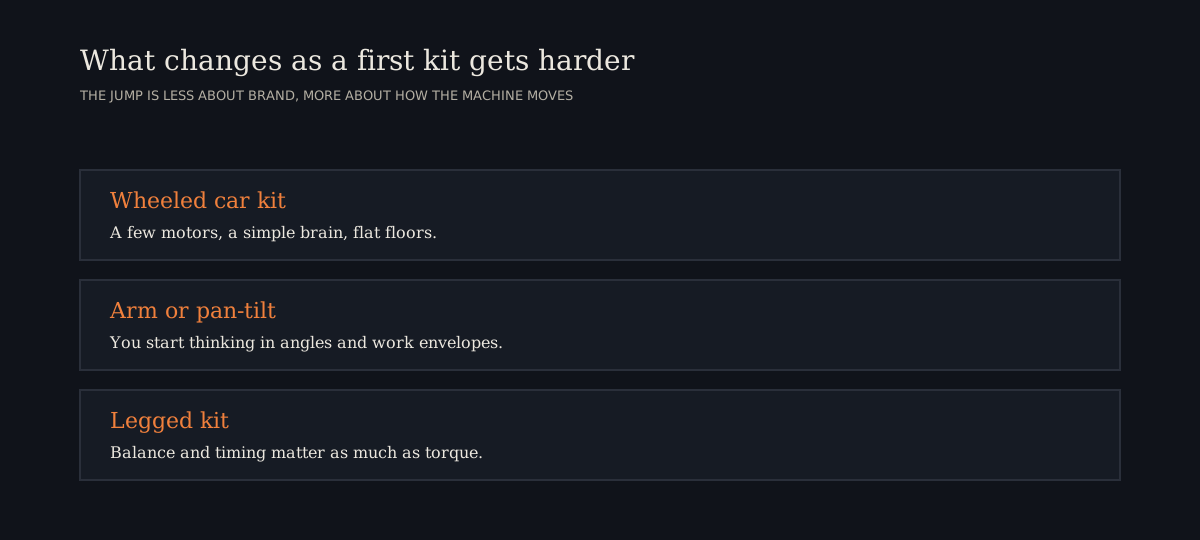
What body plan are you buying? A wheeled car will teach differential drive quickly and will not teach legs. A small arm will teach joints and reach and will not teach you much about driving across a room. Pick the plan that matches the question you have, not the one that looks most like a movie robot.
Budget, support, and the extra parts you will want
The price on the box is rarely the full price of the project. You may want extra batteries, a charger, spare gears, or a sensor the base kit does not include. Read what is in the box. A "starter" kit that omits the charger or the cable you need is a more expensive kit than it looks.
Also look for documentation that shows wiring and code, not only a lifestyle photograph. A manufacturer or a community that publishes examples you can read is worth more than a slightly nicer plastic shell. When a part breaks, and it will, you want a named part you can order, not a unique moulding with no spare.
How this sits with the rest of the site
Once the kit is on the table, the other guides on this site are meant to make the parts less mysterious. Motors, body plans, and closed-loop control are the same ideas you will meet in a first build, written so you can use them without a lecture hall.
A first kit will not, by itself, build a star-scale machine. That is not its job. Its job is to make motion, sensing, and control into things you have seen with your hands. The larger story, if you want it, lives on Type 2 Civilization and Kardashev II. The hands come first, even when they are small.
Common questions
Do I need to start with a kit, or can I build from loose parts?
You can start from loose parts if you already like wiring and you can accept a slower first success. A kit is useful because the mechanical pieces already fit together, so you can reach the motors and the code sooner.
Is a more expensive kit always a better teacher?
No. A cheaper kit that you can open, program, and repair will often teach more than an expensive one that you are not meant to take apart.
Are the kit names on the home page affiliate links?
No. As of this writing they are ordinary links, chosen with a reason and a catch. If that ever changes, the affiliate disclosure and the link itself will say so.