How electric motors move robots
A motor turns electrical power into rotation. The rest of the robot is a way of steering that turn toward a job.
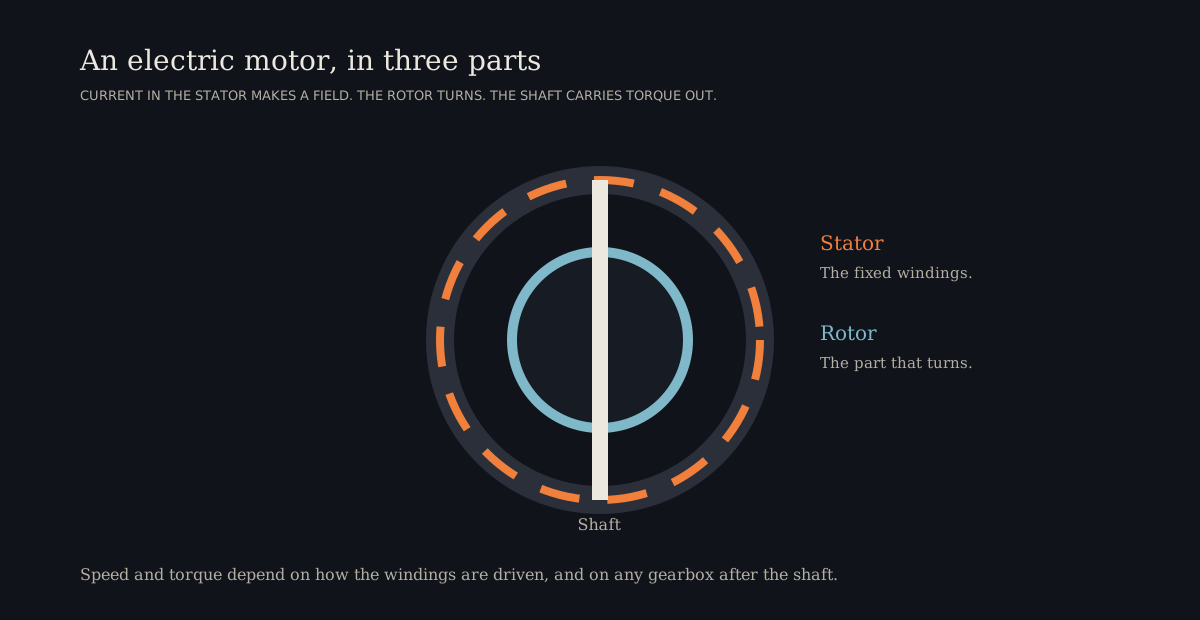
A motor is a controlled spin
At the bottom of almost every moving robot is a simple event: a current in a wire, a magnetic field, and a shaft that turns. An electric motor exists to make that turn reliable and controllable. Wheels, joints, propellers, and grippers are just ways of using the shaft.
You do not need the full electromagnetic theory to choose among the motors you will actually meet. You need to know what each kind is good at, and what it will not do for you. Three types do most of the work in small robots: ordinary DC motors, hobby servos, and steppers.
DC motors, servos, and steppers
A DC motor spins when you give it voltage. Faster if you give it more, in the usual simple case, and in reverse if you swap the leads or the drive signal. It does not, by itself, know where it is. If you want a wheel to hold a speed or a shaft to stop at an angle, you have to add sensing and control, or pick a different motor.
A hobby servo is a small package that already includes a motor, a gear train, a position sensor, and a control circuit. You ask it to go to an angle, usually with a short pulse, and it holds that angle against a modest load. That is why servos show up in robot arms and steering linkages. They are less happy when you want continuous, fast rotation, unless you have a special continuous-rotation type, which then gives up the usual angle control.
A stepper motor moves in small, fixed steps. Each pulse from the controller advances the shaft by a known angle, so you can keep track of position by counting pulses, as long as the motor has not missed a step under too much load. Steppers are common where you want to move to a place and stay there, such as a small gantry or a precise joint, without fitting a separate encoder. They can run warm, and they can stall if you ask for too much torque at too high a speed.
Gears, torque, and speed
Motors like to spin fast, with modest torque. Robot work often wants the opposite: slower motion with enough force to lift a limb or push a robot up a slope. Gears trade speed for torque. A gearbox on a motor is not a decoration. It is the reason a small motor can lift anything at all.
The trade is real. You gain force and lose speed. You also introduce backlash, the little slack in the teeth that makes a joint feel imprecise when it reverses. Good mechanical design spends as much time on this as on the electrical hookup. The motor is only half of the actuator.
From a turning shaft to a robot that works
Once you can turn a shaft on command, the rest of the machine is a question of body plan and of control. Wheels, legs, and arms covers the body plans. Sensors and closed-loop control covers the loop that keeps the motion on target when the load changes.
If you are choosing a first kit, you will meet these motors quickly, often without being told which one you are holding. Choosing a first robot kit is a longer guide to that choice. None of this requires a factory floor. It is the same physics that a much larger machine would use to assemble collectors, habitats, or other machines far from a workbench. Type 2 Civilization is about why that larger work might be worth doing. This site is about how motion actually happens.
Common questions
Is a servo a different kind of motor, or a motor plus extras?
In the hobby-robot sense, a servo is a package: a motor, gears, a position sensor, and a small controller, sold as one unit. The motor inside is still an electric motor.
Can I run a robot on one kind of motor only?
Often, yes, for a simple machine. A wheeled kit may use only DC motors. A small arm may use only servos. Mixed machines are common once the jobs differ, because no single type is best at every job.
Do larger industrial robots use the same three types?
They use the same physics, often with more precise motors, feedback, and drives. The hobby categories still help as a first map, but a factory arm is not just a large servo horn.