Wheels, legs, and arms
The motor is only the start. The body decides what the motion is for.
Wheels and tracks
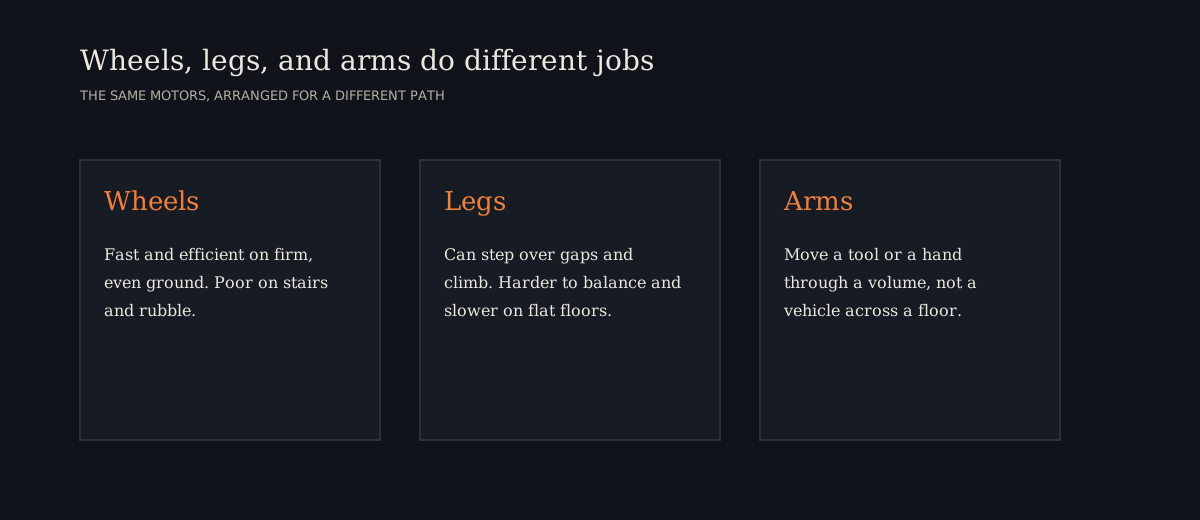
Most robots that have to travel on fairly even ground use wheels. Many of them have no steering wheel. Two drive wheels run at different speeds: equal speeds go straight, unequal speeds curve, and opposite directions spin the robot on the spot. That is differential drive, and it is the reason a small kit car can turn in a tight space without a rack-and-pinion.
Tracks, as on a small excavator-style robot, spread the load and keep more of the vehicle in contact with soft or broken ground. They still often steer by running the two sides at different speeds. The cost is friction, weight, and more parts to maintain. Wheels are efficient on floors and roads. Tracks earn their keep where wheels would dig in or fall into gaps.
Legs and balance
A legged robot stays up by keeping its weight over the feet that are on the ground. Four-legged robots can walk slowly with three feet planted and move the fourth. Two-legged robots have a harder job. They must keep catching themselves, step after step, because a single support foot is a narrow base.
Legs are worth the trouble when the ground is uneven, stepped, or full of gaps that wheels cannot cross. They are not automatically better. They cost more joints, more control, and more energy for the same trip on a smooth floor. If the job is a warehouse aisle, wheels usually win. If the job is a pile of rocks, legs or a mix of legs and wheels may be the better plan.
Arms, joints, and work
Travel gets a robot to a place. An arm does work when it arrives. Each joint adds one way to move. Six joints are enough, in principle, to put a gripper at any point within reach, facing any direction, which is the idea behind the reach envelope.
The hard part is not adding joints. It is coordinating them. "Put the gripper there" is easy to say and harder to turn into six angles that do not hit the table, the body, or a limit switch. That coordination is a math problem and a sensing problem. Sentient Cloud is about the computing side. This page is about why the body needs that computing in the first place.
Rotors, and robots that leave the floor
A quadcopter has no rudder or flaps in the aircraft sense. It flies by changing the speed of four propellers. Spin the rear pair faster and the craft tips forward. Two propellers spin clockwise and two the other way, so the body does not twist. The same idea, with more rotors or with wings, shows up in larger machines, but the core is still motors changing speed many times a second.
Flying robots trade the friction of the ground for a constant spend of energy just to stay up. That is why they are superb for looking around and poor for standing still all day with a heavy tool. Body plan is a choice about energy as well as about shape. For the motors themselves, see How electric motors move robots. For the loop that keeps any of these machines from drifting, see Sensors and closed-loop control.
Common questions
Why don't all robots just use legs, since people do?
People already have legs, and we walk on mixed ground. On smooth floors, wheels are simpler, more efficient, and easier to control. Legs pay off when the ground is a bad match for wheels.
Is a track just a wheel with a belt on it?
In spirit, yes: the drive still turns, and the vehicle still steers by running the two sides at different speeds. In practice, the belt, the bogies, and the extra friction make it a different machine to build and to maintain.
How many joints does an arm need?
It depends on the job. A simple up-and-down grabber may need only two or three. Six is the usual number when you want to place a tool at a point and also choose its orientation, within the arm's reach.