What a reach envelope is
It is a map of the places a tool can actually go, not a picture of the arm at rest.
A region, not a single pose
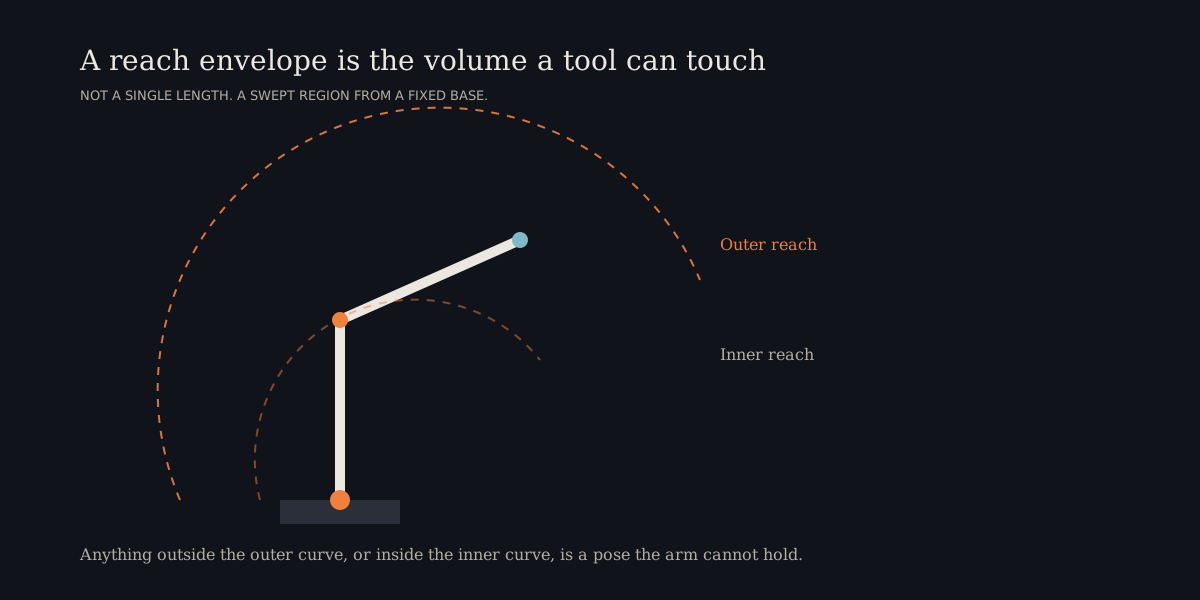
When people talk about a robot arm, they often show it in one pose, as if that were the machine. The more useful picture is the set of points the tool can reach, and the set of orientations it can hold when it gets there. That set is the reach envelope, sometimes called the workspace.
The envelope is shaped by the lengths of the links, the way the joints are stacked, and the limits of each joint. It is rarely a perfect sphere. There are holes in it, close to the body, and there are edges where the arm is stretched out and has no more length to give. Near those edges the arm may still reach a point, but only in one awkward posture, with little leftover motion for fine adjustment.
Why six joints keep coming up
A tool in space has six degrees of freedom if you care about both position and orientation: three for where it is, and three for which way it points. An arm with six joints can, in principle, match those six numbers inside its envelope. Fewer joints mean you give something up, often the ability to choose orientation, or the ability to reach around an obstacle.
More than six joints can help the arm thread through clutter, because there is leftover motion: different joint combinations can put the tool in the same place. That leftover motion is useful, and it also makes the math harder. Six is a common compromise for a general-purpose arm, not a law of nature.
Reach is not the same as strength or precision
An envelope tells you where the tool can go. It does not tell you how hard the arm can push when it gets there, or how closely it can hold a position. A long, slender arm can have a large envelope and still be a poor choice for a heavy tool. A short, stiff arm can be strong and precise in a small region.
Precision also depends on sensors, backlash in the gears, and the control loop. A well-drawn envelope on a datasheet can hide a floppy wrist. When you read a specification, treat reach, payload, and repeatability as three different claims. Motors and closed-loop control are the reasons those claims stand or fall.
How to think about it with your own arm
You can feel a reach envelope without any hardware. Stand in one place, lock your feet, and see which points on a table you can touch. Now try to touch the same point with your palm facing up, then down. Some points you can reach only in one posture. Some you cannot reach at all without stepping, which is to say, without moving the base of the arm. That last fact is why a mobile robot with a modest arm can outperform a larger fixed arm: the base extends the envelope by moving the whole machine.
If you are choosing a kit or a first arm project, ask what the tool actually has to reach, and from where the base can sit. A dramatic photograph of a long arm is a weaker guide than a sketch of the work area. Choosing a first robot kit comes back to that habit.
Common questions
Is the reach envelope the same as the maximum reach listed on a box?
Maximum reach is usually one number, the farthest the tool can get from the base. The envelope is the whole region, including the holes and the awkward edges. The single number is a start, not the map.
Can a five-joint arm still be useful?
Yes, if the job does not need a fully chosen orientation, or if a fixture holds the part in a known way. Many simple pick-and-place jobs can live with fewer than six joints.
Does adding a gripper change the envelope?
A gripper has its own length and its own motion, so it changes the places the fingertips can go. A datasheet may quote reach to the wrist, or to the tool tip. Those are different measurements. Check which one you are looking at.